
Health and Care Research
What is health and care research and why is it important?
We are committed to our population living happier and healthier lives. Research is one way that we can make this happen by providing the evidence to improve treatments and care. This could be by testing new medicines or vaccines or by completing questionnaires to help us understand how people feel about the care they receive.
Benefits to taking part in research can include learning more about your health or receiving closer monitoring. Taking part in a project may not always help you directly, but you will be helping to improve services and treatments now and in the future.
Health and care research adds to our knowledge and understanding about diagnoses, treatments and care, and people’s lived experiences. This knowledge helps us to deliver better services and contributes to the best health and wellbeing for people. Publishing the learning from research widely can positively impact health and care locally, regionally, nationally and internationally.
There is a specific need to increase the diversity of people who get involved in research, both as research recruits, and in study design. We know there is a prevalence of white, older people who get involved in research. Without diverse participants in research, there is a risk that research outcomes will not be as effective across diverse population groups and that research trials will not be designed to meet the needs of a diverse population.
Research Engagement Network
The Research Engagement Network supports and champions the involvement of patients and the public in research, working with volunteers and Voluntary, Community, Faith and Social Enterprises (VCFSEs) across all stages of the research process, and providing advice and guidance to researchers on good practice.
The team also work to raise the profile of research to encourage participation in and engagement with research studies by working with local communities. In collaboration with our system partners we are delivering an NHS England funded initiative called Research Engagement Networks (REN).
Our local Research Engagement Network is coordinated by the Norfolk and Suffolk Integrated Care Board (ICB), the Regional Research Delivery Network (RRDN) and in collaboration with Thinklusive.
This initiative creates a platform for researchers to exchange experiences, foster learning and support under-represented groups to participate in research.
The Network:
- Builds a local research environment that is supportive and inclusive for our diverse communities.
- Builds trusting, mutually beneficial relationships with the community and VCFSE sector.
- Listens to, and understands, local communities better.
- Collaborates with community members and organisations to make research more inclusive and representative.
- Highlights the need for making reasonable adjustments within research happening locally.
- Provides a check and challenge to local research teams to create more accessible research.
- Offers input, ideas, and recommendations to teams at all stages of the research process.
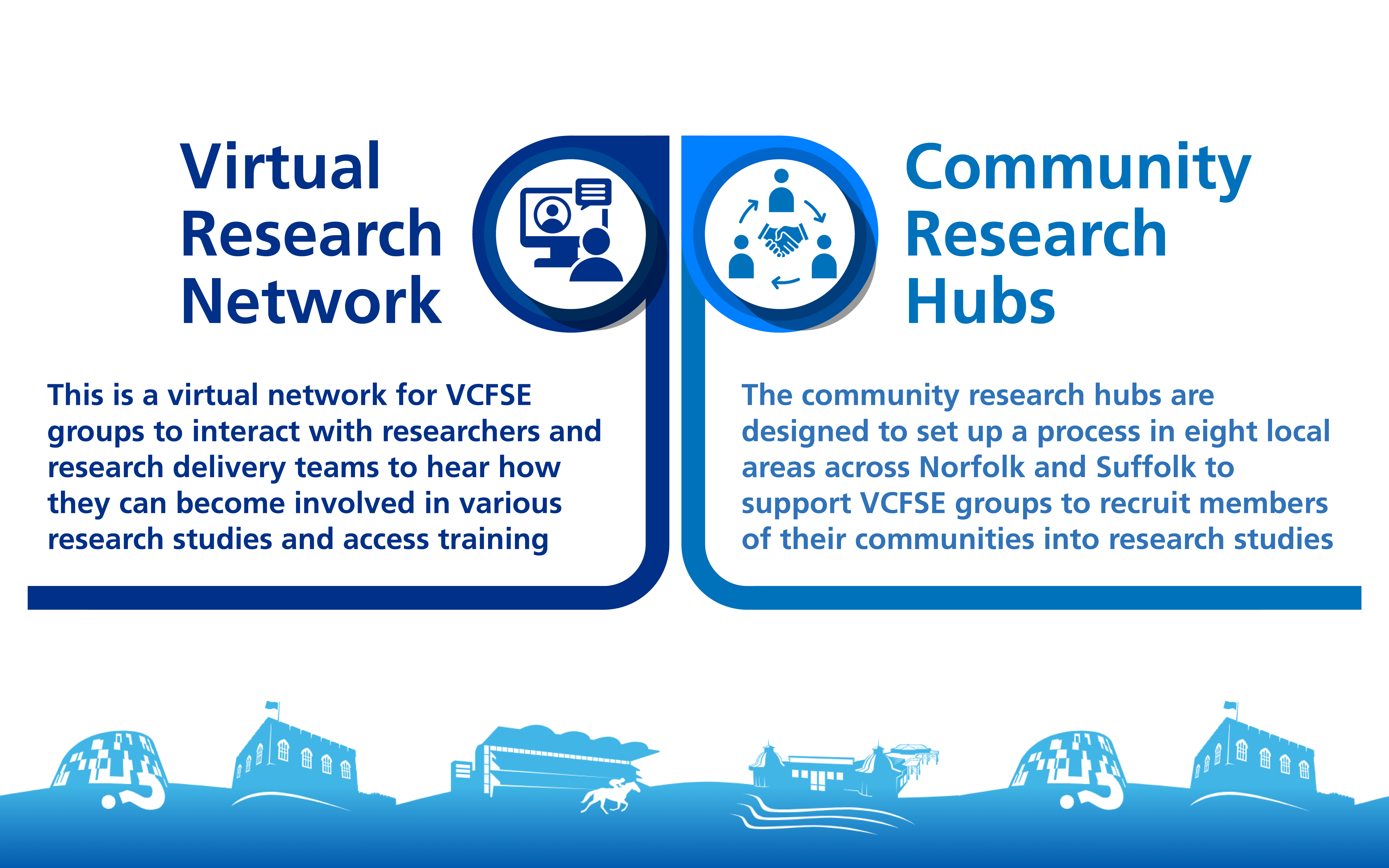
The Research Engagement Network for Norfolk and Suffolk comprise two key elements: the virtual network and community research hubs. These are funded jointly by NHS England and the Regional Research Delivery Network.
Virtual Network
What is it?
This is a virtual network for VCFSE groups to interact with researchers and research delivery teams to hear how they can become involved in various research studies and access training.
What does it do?
The purpose of the network is to highlight research projects to VCFSE groups that are interested in research and to hear from researchers who want to engage with VCFSE groups to enhance their studies.
Max Clark (Thinklusive) chairs a meeting every two months (1 hour, online) to hear presentations from researchers and research delivery teams to highlight relevant research projects to VCFSE groups. Max also regularly shares research projects via email so that VCFSE groups can take part in research if it is relevant to them.
Who can attend and take part?
This network is open to anyone interested in research across Norfolk and Suffolk, working in a VCFSE organisation. You do not have to have any previous experience of research. We know research can be intimidating, and there is usually lots of conversation between colleagues. These meetings are informal, and it is ok to just listen to the conversation.
What do I need to do to join the network?
Please complete the survey below to register to receive emails and the dates of upcoming meetings.
Community Research Hubs
What are they?
The community research hubs are designed to set up a process in eight local areas across Norfolk and Suffolk to support VCFSE groups to recruit members of their communities into research studies. This is important as it makes research more representative of the population and gives access to new treatment approaches that wouldn’t have been available previously.
What do they do?
Each of the hubs is a collection of around three VCFSE groups that have come together to form a core group. Currently, hubs are up and running in Great Yarmouth, Thetford, Waveney, King’s Lynn and Norwich. The VCFSE groups work together with the Integrated Care Board (ICB), Regional Research Delivery Network, Community Action Norfolk and other partners to find ways in which they can recruit members of their communities into research studies or they can support research nurses to run clinics in their community spaces.
To support the hubs, the ICB brings together all partners with the VCFSE groups that are leading each hub once a month to share learning and find out what support is needed.
Who can take part?
Once hubs are established, VCFSE groups in those areas are advised to contact their local hub in the first instance to see how they can get involved. Information on the local hubs can be obtained by contacting nwicb.researchinnovation@nhs.net. We are in the process of establishing three new hubs across Suffolk and the process for this is being led through the virtual network.
Get Involved - Be part of Research
Be Part of Research is a UK-wide service that helps people understand what research is and what it might mean to take part. It also shows what research is currently happening across the UK.
You can create a free account or search for trials and studies into health conditions you’re interested in, at locations near you. See video below for more details. The link to sign up is: https://bepartofresearch.nihr.ac.uk/
-
Complaining about complaints
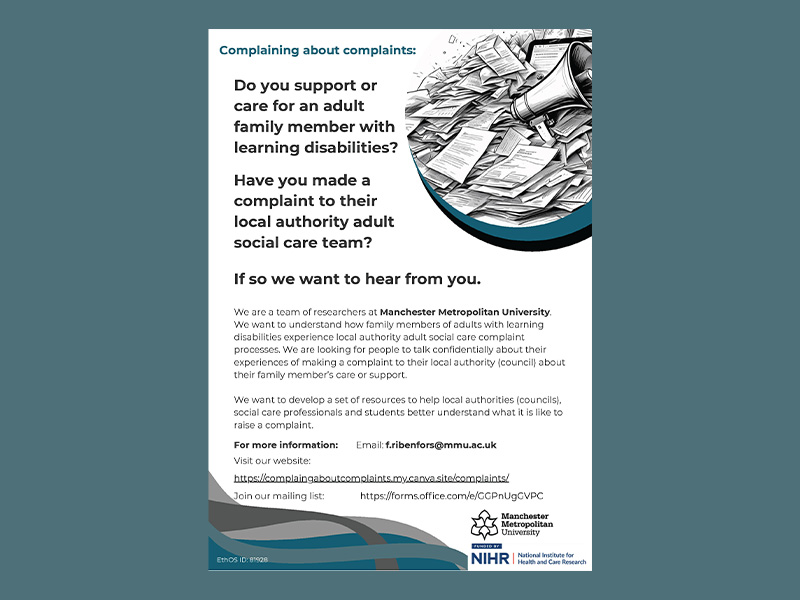
Do you support or care for an adult family member with learning disabilities?
Have you made a complaint to their local authority adult social care team?
If so we want to hear from you.
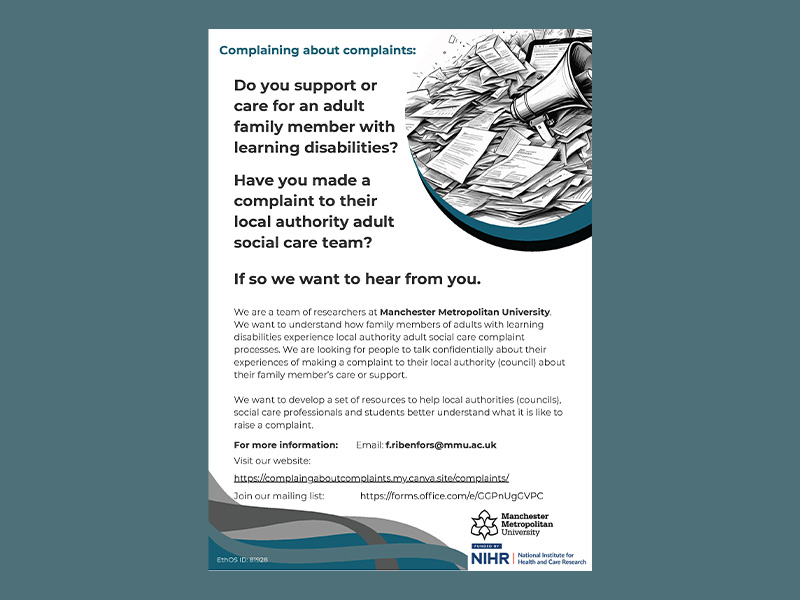 Image Caption
We are a team of researchers at Manchester Metropolitan University.
We want to understand how family members of adults with learning disabilities experience local authority adult social care complaint processes. We are looking for people to talk confidentially about their experiences of making a complaint to their local authority (council) about their family member’s care or support.
We want to develop a set of resources to help local authorities (councils), social care professionals and students better understand what it is like to raise a complaint.
Are you a family member of an adult with learning disabilities who has made a complaint to their relatives adult social care department?
or,
Are you a local authority member of staff who has experience of receiving, handling or managing complaints from family members regarding adult social care?
If so and you would be willing to talk to a researcher about your experiences we would love to hear from you. Please email f.ribenfors@mmu.ac.uk
For more information:
email: f.ribenfors@mmu.ac.uk
Visit our website: https://complaingaboutcomplaints.my.canva.site/complaints/
Join our mailing list: https://forms.office.com/e/GGPnUgGVPC
EthOS ID: 81928
-
Webinar: How to write a plain English summary
 Webinar: How to write a plain English summaryMar 24, 2026 12:00 PM
 An integral part of research that is funded by NIHR is to ensure that patients, carers, service users and the public have the opportunity to shape and influence the relevance, quality and impact of our health and care research.A plain English summary is a clear, brief summary of the research, written for members of the public rather than researchers or professionals. This webinar will be relevant to you if you are an NIHR-funded researcher or a researcher applying for an NIHR career development award.The webinar will cover:➡️ NIHR’s Strategic Commitments for Public Partnerships➡️ explanation of plain English summaries and their importance➡️ how to write one and what to include➡️ what support is available through the Research Support Service (RSS)➡️ signposting to useful resources.By attending this webinar, you will discover:➡️ an in-depth understanding of plain English summaries and how to write an effective one➡️ insights from a public contributor that you can apply to your research application.The 60-minute webinar will be facilitated by Linda Onerhime-Prince, Senior NIHR PPI Manager and Dr Jo Lally, Strategic Lead for Patient and Public Involvement and Engagement and Equality, Diversity and Inclusion, NIHR RSS.
Click here to register: https://zoom.us/webinar/register/3017719437178/WN_zaGOItLdSwiR3PnbbhLuHg#/registration
-
The Cancer Act Study: Request for Participant Recruitment Support
Dr Priya Joshi is an oncologist who is working on an MBA thesis on Access to Cancer Information. She is investigating whether The Cancer Act 1939 (which restricts advertising of cancer treatment in the UK) remains fit for purpose in today’s digital environment. Dr Joshi is looking at how social media impacts access to cancer information, potential barriers to evidence-based treatment knowledge for UK patients and understanding how best to counter misinformation online.
The research consists of an anonymous online survey, which would take between 20-30 mins. Participants would be one of four key groups:- Adults who have received cancer treatment in the UK within the last three years (or a family member or friend who completes the survey on the patient’s behalf, with permission).
- Healthcare professionals who consult with cancer patients.
- Pharmaceutical marketing and compliance personnel.
- Managers in third sector, or private healthcare.
Please consider taking or disseminating the survey within your networks.
Survey links:
- Adults who have received cancer treatment in the UK within the last three years (or a family member or friend who completes the survey on the patient’s behalf, with permission): https://wbs.qualtrics.com/jfe/form/SV_09F4M9uqfjsX3tI
- Healthcare professionals who consult with cancer patients: https://wbs.qualtrics.com/jfe/form/SV_6hYhlK8ZxsGYsFE
- Managers in private or third sector healthcare responsible for delivering cancer care, those who oversee or influence patient pathways, service provision, or communications related to cancer care: https://wbs.qualtrics.com/jfe/form/SV_7OGoal6Fkt3rxjM
-
Increasing Diversity in Research Participation
A good practice guide for engaging with underrepresented groups
This guide is designed for researchers from a wide and varied audience.
Its purpose is:
• To help researchers understand why research participation might be low in a group
• To provide meaningful insights into working with groups where participation in research is low
• To provide practical suggestions to increase participation in research.
This work was undertaken in two phases:
1. A review of the available literature, contemporary media and online insights to explore existing understanding and resources
2. Outreach work with six underrepresented groups to understand challenges and enablers to getting involved in research, and to co-develop practical tips to address these
Insights drawn from both phases of work have underpinned the development of this guide, which has been co-developed with the groups in question.
The first half of this guide provides context, background, and insights into the challenges around recruiting a diverse participant base.
The second half outlines practical tips, guidance, and case studies from the underrepresented groups. This guide is relevant to all research professionals but for brevity throughout the guide we refer to the audience as those working in patient and clinical research.
View the good practice guide, here: https://www.england.nhs.uk/aac/wp-content/uploads/sites/50/2023/02/B1905-increasing-diversity-in-research-participation-v2.pdf.pdf
-
Call for Participants - Exploring the gender-based harassment and sexism on the wellbeing of teachers in secondary schools
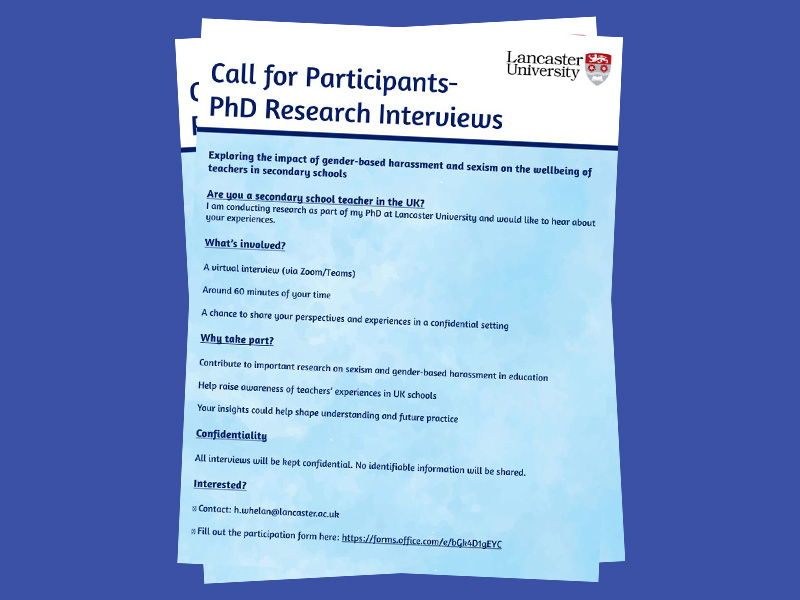
The purpose of this study is to investigate what experiences of sexism and gender-based harassment teachers experience during their work both from students and colleagues.
It will give people the opportunity to share your experiences in as much detail as they feel comfortable.
The study will also look at the wellbeing and retention of teachers to investigate whether there is a link between experiences of gender-based harassment and plans to leave the profession.
If you are interested in taking part in this research, please fill out your details and the researcher will be in touch shortly: https://forms.office.com/pages/responsepage.aspx?id=Ec2bnHqXnE6poLxzQJAWSqh7QvuC9qVHlbzKnx6U2XxUMzRJRVpBS041U0ZOSVJLVE44TExFSDA2OS4u&route=shorturl
-
NIHR Webinar - How to Develop a PPI Group
 NIHR Webinar - How to Develop a PPI GroupFeb 18, 2026 10:30 AMWhat is the webinar series about?Patient and public involvement is a prerequisite for all research funded by NIHR. It can enhance the relevance and quality of research and help build trust in the research and its outcomes.But how do we do it effectively? What lessons can we learn from when things didn’t go as well as intended? And how do the UK public involvement standards find expression in practice?This webinar series, drawing on the experiences of public contributors and researchers, will showcase examples of patient and public involvement in NIHR funded research. Our next webinar of the series is called "How to Develop a PPI Group"Speakers include: Christina King - Chair of the Prehabilitation PPI group & Sarah Murray - Chair of the National PPI Group for the BHF CRC for Cardiac Surgery at Leicester University.About this event:The Bristol-based PPI group has worked as part of the heart surgery prehabilitation research team for four years, evolving from a development grant partner into an essential component of the current study. We will reflect on our journey, discussing both the successes we’ve celebrated and the hurdles we’ve overcome. By sharing this practical knowledge, we hope to offer valuable insights to the research community and public contributors on how PPI can effectively co design and improve medical research.
Book your place, here: https://zoom.us/webinar/register/WN_lsa7wAnaT8OwoeSwb0zfiA#/registration
-
Can technology assist in autism diagnosis?
New active autism study!😮 Can technology assist in autism diagnosis and address the current long NHS wait times?
Are you autistic? Waiting for an Autism diagnosis? Or a Health Care Professional? Register to take part in our study! If you take part, you will receive a £10 Amazon voucher and contribute to some very impactful research.
Get involved by scanning the QR code or following this link: Participant Information Form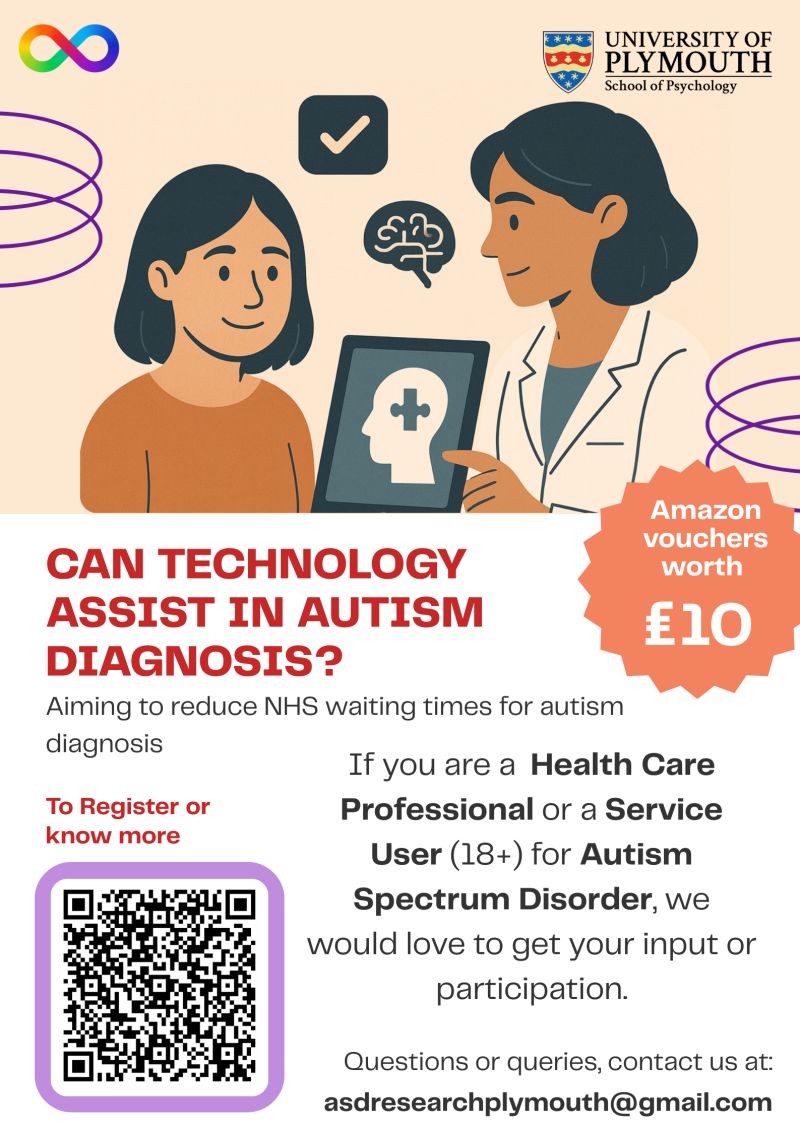
-
What is it like to grieve who the person was before their brain injury?

A call for participants from Elizabeth Gilmour at the University of Plymouth:
"We are currently seeking family members of people with Brain Injuries (acquired or traumatic) to participate in an interview to discuss their feelings of grief after their family member sustained their injury and who are still alive. Whether you are a parent, a child, or an extended family member, we would love to hear from you.
This research aims to get a better understanding of your experiences so that we can better help. The interview should not last more than an hour and a half (You do not have to use all the time), and will be on Zoom. If you would prefer, an in-person meeting can be arranged at the University of Plymouth. You will be sent the potential interview questions beforehand so you can decide whether you are happy to answer them.
I understand that discussing these topics can be challenging, especially with someone unfamiliar. If you have any questions, please get in touch, and I would be happy to answer them.
If you would like to get involved, have questions, or want more information, please email: elizabeth.gilmour@plymouth.ac.uk" -
Developing a formal public contributor agreement for public involvement at the Health Research Authority
The Health Research Authority (HRA) is looking for members of the public to get involved in 2 online workshops to help us develop a formal public contributor agreement.
Why are we doing this work?
We had previously developed the HRA Ways of working with the HRA Community Committee to support our duty to ensure people are treated with dignity and respect, but we now want to be clear how we will take action if expectations are not met.
What is the activity?
We would like your involvement in developing a formal public contributor agreement that will be made between the HRA and public contributors at the start of their involvement with us.
We would also like your input into what actions may be taken by the HRA if expectations are not met, ensuring that everyone is treated consistently and fairly.
What is involved?
We have developed a draft agreement that we would like you to review and then share your thoughts on in two workshops that we will hold on Thursday 26 February 2026 and Thursday 19 March 2026.
Both workshops will be held from 10am to 12pm virtually on Zoom and we will include a 15-minute break.
The public contributor draft agreement will be sent to you one week in advance for you to review.
We will hold 2 workshops with 8 members of the public and 8 members of HRA staff where everyone can let us know if the draft agreement meets the purpose for which it is being developed.
What difference will I make?
Your input will help us make sure that going forward, we can have better relationships with our public contributors because everyone is clear on expectations from the outset, and what to do if this is not the case, so that everyone is treated consistently and fairly.
You will also help make sure that the agreement is developed using wording that is inclusive and easy to understand.
We will listen to feedback from you and HRA staff taking part in both workshops and let you know what changes we have made as a result of the workshops. Where we cannot action your suggestions, we will explain why.
What support will I receive?
Our HRA Community Ways of Working sets out what you can expect when working with us, and our expectations for working together respectfully, inclusively and impactfully.
We have a small team at the HRA who will support your involvement with this piece of work.
If you are invited to take part in this activity, we will ask you to share your access and support needs and any requests for reasonable adjustments.
What skills or experience do I need to take part?
You should have experience completing preparatory reading or materials ahead of group sessions and be able to bring insights or reflections from this pre‑reading into the workshop discussions.
You should be comfortable contributing to group conversations, sharing perspectives, and actively participating in all aspects of the workshop including in breakout rooms.
You should have the ability to listen to and respect different opinions, recognising that others may have different backgrounds, experiences, and perspectives.
To apply, please provide your answers to the questions in our accessible online form
If you experience any problem using the accessible form, please email the public involvement team for support using ‘agreement’ in the email subject line or call us on 020 7104 8161.
The deadline to apply is by midday on Monday 2 February 2026.
How will you decide who will be involved?
We will remove your name from your application and two members of HRA staff will consider your responses. We will shortlist people who have met the criteria to join the group. If we receive many applications that meets the criteria, we will select at random.
We will let you know whether you have been successful by Wednesday 11 February 2026.
Will I receive payment?
In line with our payments policy, we can offer:
- £25 to prepare for being involved in this work by reading the documents that we send you and attending a short briefing meeting if required
- £50 for taking part in an informal workshop
- £25 for attending a meeting to exchange feedback on your involvement, to include preparation and reviewing notes
Will my expenses be covered?
Yes. It is our policy to cover reasonable expenses, if agreed in advance. For example, travel, additional childcare, or for a carer or personal assistant. We offer a £5 contribution towards any incidental expenses incurred by attending online meetings.
-

Email m.twigg1@nhs.net -
-
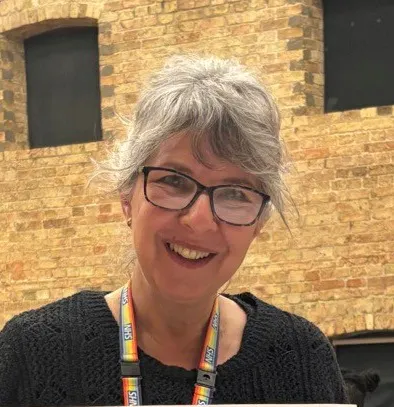
REN Network Chair & Thinklusive