Health and Care Research

What is health and care research and why is it important?

We are committed to our population living happier and healthier lives. Research is one way that we can make this happen by providing the evidence to improve treatments and care. This could be by testing new medicines or vaccines or by completing questionnaires to help us understand how people feel about the care they receive.


Benefits to taking part in research can include learning more about your health or receiving closer monitoring. Taking part in a project may not always help you directly, but you will be helping to improve services and treatments now and in the future.


Health and care research adds to our knowledge and understanding about diagnoses, treatments and care, and people’s lived experiences. This knowledge helps us to deliver better services and contributes to the best health and wellbeing for people. Publishing the learning from research widely can positively impact health and care locally, regionally, nationally and internationally.


There is a specific need to increase the diversity of people who get involved in research, both as research recruits, and in study design. We know there is a prevalence of white, older people who get involved in research. Without diverse participants in research, there is a risk that research outcomes will not be as effective across diverse population groups and that research trials will not be designed to meet the needs of a diverse population.


Get Involved - Be part of Research

Be Part of Research is a UK-wide service that helps people understand what research is and what it might mean to take part. It also shows what research is currently happening across the UK.


You can create a free account or search for trials and studies into health conditions you’re interested in, at locations near you. See video below for more details. The link to sign up is: https://bepartofresearch.nihr.ac.uk/.


Research Engagement Network

The Research Engagement Network supports and champions the involvement of patients and the public in research, working with volunteers and Voluntary, Community, Faith and Social Enterprises (VCFSEs) across all stages of the research process, and providing advice and guidance to researchers on good practice.


The team also work to raise the profile of research to encourage participation in and engagement with research studies by working with local communities. In collaboration with our system partners we are delivering an NHS England funded initiative called Research Engagement Networks (REN).


Our local Research Engagement Network is coordinated by the Norfolk and Suffolk Integrated Care Board (ICB), the Regional Research Delivery Network (RRDN) and in collaboration with Thinklusive.


This initiative creates a platform for researchers to exchange experiences, foster learning and support under-represented groups to participate in research.


The Network:


  • Builds a local research environment that is supportive and inclusive for our diverse communities.
  • Builds trusting, mutually beneficial relationships with the community and VCFSE sector.
  • Listens to, and understands, local communities better.
  • Collaborates with community members and organisations to make research more inclusive and representative.
  • Highlights the need for making reasonable adjustments within research happening locally.
  • Provides a check and challenge to local research teams to create more accessible research.
  • Offers input, ideas, and recommendations to teams at all stages of the research process.

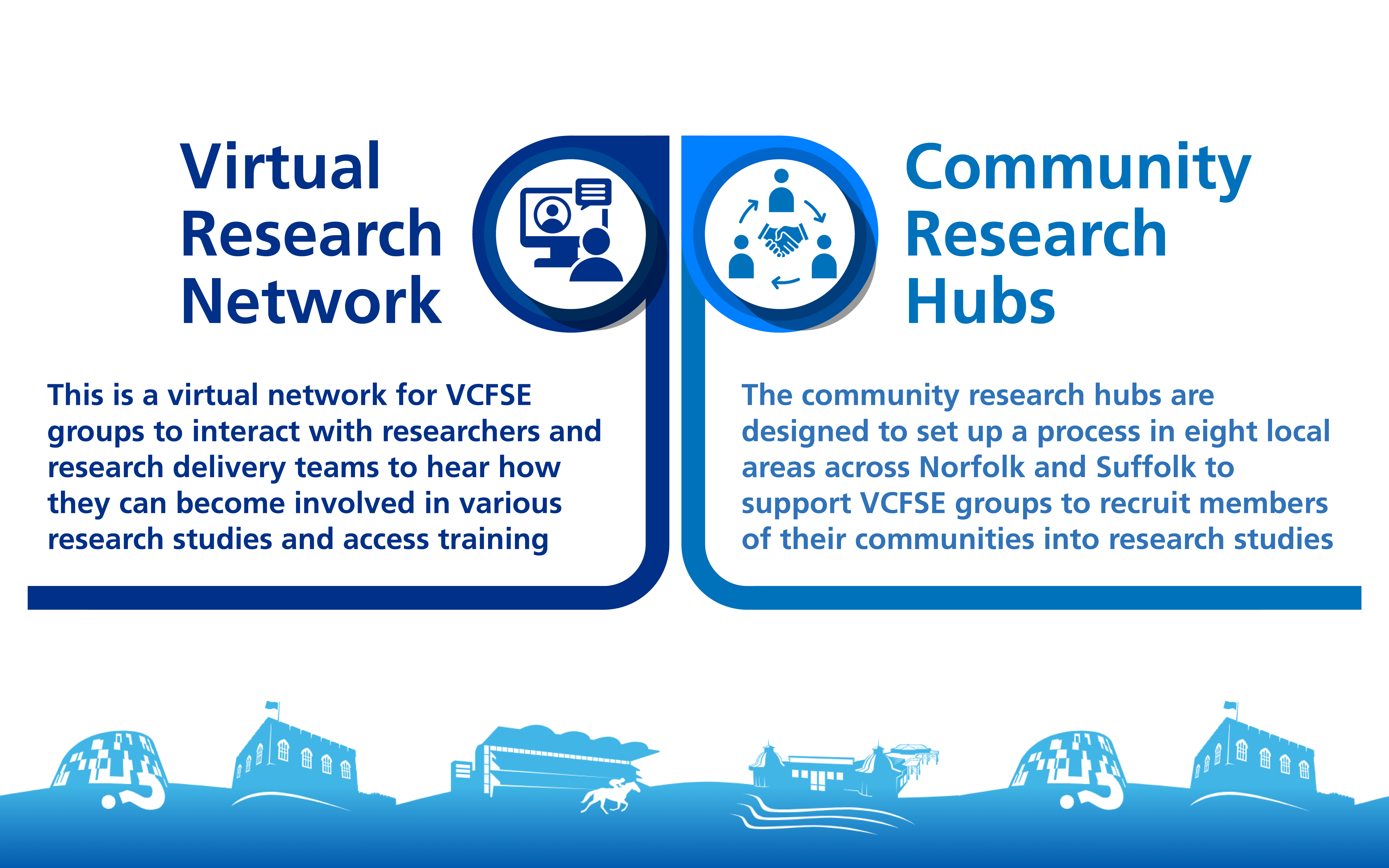
The Research Engagement Network for Norfolk and Suffolk comprise two key elements: the virtual network and community research hubs. These are funded jointly by NHS England and the Regional Research Delivery Network.


Virtual Network

What is it?

This is a virtual network for VCFSE groups to interact with researchers and research delivery teams to hear how they can become involved in various research studies and access training.


What does it do?

The purpose of the network is to highlight research projects to VCFSE groups that are interested in research and to hear from researchers who want to engage with VCFSE groups to enhance their studies.


Max Clark (Thinklusive) chairs a meeting every two months (1 hour, online) to hear presentations from researchers and research delivery teams to highlight relevant research projects to VCFSE groups. Max also regularly shares research projects via email so that VCFSE groups can take part in research if it is relevant to them.


Who can attend and take part?

This network is open to anyone interested in research across Norfolk and Suffolk, working in a VCFSE organisation. You do not have to have any previous experience of research. We know research can be intimidating, and there is usually lots of conversation between colleagues. These meetings are informal, and it is ok to just listen to the conversation.


What do I need to do to join the network?

Please complete the survey below to register to receive emails and the dates of upcoming meetings.


Community Research Hubs

What are they?

The community research hubs are designed to set up a process in eight local areas across Norfolk and Suffolk to support VCFSE groups to recruit members of their communities into research studies. This is important as it makes research more representative of the population and gives access to new treatment approaches that wouldn’t have been available previously.


What do they do?

Each of the hubs is a collection of around three VCFSE groups that have come together to form a core group. Currently, hubs are up and running in Great Yarmouth, Thetford, Waveney, King’s Lynn and Norwich. The VCFSE groups work together with the Integrated Care Board (ICB), Regional Research Delivery Network, Community Action Norfolk and other partners to find ways in which they can recruit members of their communities into research studies or they can support research nurses to run clinics in their community spaces.


To support the hubs, the ICB brings together all partners with the VCFSE groups that are leading each hub once a month to share learning and find out what support is needed.


Who can take part?

Once hubs are established, VCFSE groups in those areas are advised to contact their local hub in the first instance to see how they can get involved. Information on the local hubs can be obtained by contacting nwicb.researchinnovation@nhs.net. We are in the process of establishing three new hubs across Suffolk and the process for this is being led through the virtual network.

What is health and care research and why is it important?

We are committed to our population living happier and healthier lives. Research is one way that we can make this happen by providing the evidence to improve treatments and care. This could be by testing new medicines or vaccines or by completing questionnaires to help us understand how people feel about the care they receive.


Benefits to taking part in research can include learning more about your health or receiving closer monitoring. Taking part in a project may not always help you directly, but you will be helping to improve services and treatments now and in the future.


Health and care research adds to our knowledge and understanding about diagnoses, treatments and care, and people’s lived experiences. This knowledge helps us to deliver better services and contributes to the best health and wellbeing for people. Publishing the learning from research widely can positively impact health and care locally, regionally, nationally and internationally.


There is a specific need to increase the diversity of people who get involved in research, both as research recruits, and in study design. We know there is a prevalence of white, older people who get involved in research. Without diverse participants in research, there is a risk that research outcomes will not be as effective across diverse population groups and that research trials will not be designed to meet the needs of a diverse population.


Get Involved - Be part of Research

Be Part of Research is a UK-wide service that helps people understand what research is and what it might mean to take part. It also shows what research is currently happening across the UK.


You can create a free account or search for trials and studies into health conditions you’re interested in, at locations near you. See video below for more details. The link to sign up is: https://bepartofresearch.nihr.ac.uk/.


Research Engagement Network

The Research Engagement Network supports and champions the involvement of patients and the public in research, working with volunteers and Voluntary, Community, Faith and Social Enterprises (VCFSEs) across all stages of the research process, and providing advice and guidance to researchers on good practice.


The team also work to raise the profile of research to encourage participation in and engagement with research studies by working with local communities. In collaboration with our system partners we are delivering an NHS England funded initiative called Research Engagement Networks (REN).


Our local Research Engagement Network is coordinated by the Norfolk and Suffolk Integrated Care Board (ICB), the Regional Research Delivery Network (RRDN) and in collaboration with Thinklusive.


This initiative creates a platform for researchers to exchange experiences, foster learning and support under-represented groups to participate in research.


The Network:


  • Builds a local research environment that is supportive and inclusive for our diverse communities.
  • Builds trusting, mutually beneficial relationships with the community and VCFSE sector.
  • Listens to, and understands, local communities better.
  • Collaborates with community members and organisations to make research more inclusive and representative.
  • Highlights the need for making reasonable adjustments within research happening locally.
  • Provides a check and challenge to local research teams to create more accessible research.
  • Offers input, ideas, and recommendations to teams at all stages of the research process.

The Research Engagement Network for Norfolk and Suffolk comprise two key elements: the virtual network and community research hubs. These are funded jointly by NHS England and the Regional Research Delivery Network.


Virtual Network

What is it?

This is a virtual network for VCFSE groups to interact with researchers and research delivery teams to hear how they can become involved in various research studies and access training.


What does it do?

The purpose of the network is to highlight research projects to VCFSE groups that are interested in research and to hear from researchers who want to engage with VCFSE groups to enhance their studies.


Max Clark (Thinklusive) chairs a meeting every two months (1 hour, online) to hear presentations from researchers and research delivery teams to highlight relevant research projects to VCFSE groups. Max also regularly shares research projects via email so that VCFSE groups can take part in research if it is relevant to them.


Who can attend and take part?

This network is open to anyone interested in research across Norfolk and Suffolk, working in a VCFSE organisation. You do not have to have any previous experience of research. We know research can be intimidating, and there is usually lots of conversation between colleagues. These meetings are informal, and it is ok to just listen to the conversation.


What do I need to do to join the network?

Please complete the survey below to register to receive emails and the dates of upcoming meetings.


Community Research Hubs

What are they?

The community research hubs are designed to set up a process in eight local areas across Norfolk and Suffolk to support VCFSE groups to recruit members of their communities into research studies. This is important as it makes research more representative of the population and gives access to new treatment approaches that wouldn’t have been available previously.


What do they do?

Each of the hubs is a collection of around three VCFSE groups that have come together to form a core group. Currently, hubs are up and running in Great Yarmouth, Thetford, Waveney, King’s Lynn and Norwich. The VCFSE groups work together with the Integrated Care Board (ICB), Regional Research Delivery Network, Community Action Norfolk and other partners to find ways in which they can recruit members of their communities into research studies or they can support research nurses to run clinics in their community spaces.


To support the hubs, the ICB brings together all partners with the VCFSE groups that are leading each hub once a month to share learning and find out what support is needed.


Who can take part?

Once hubs are established, VCFSE groups in those areas are advised to contact their local hub in the first instance to see how they can get involved. Information on the local hubs can be obtained by contacting nwicb.researchinnovation@nhs.net. We are in the process of establishing three new hubs across Suffolk and the process for this is being led through the virtual network.

  • RHITE: a public register for individuals interested in taking part in brain injury research

    supporting image

    RHITE: Register for Healthcare Involvement and Technology Evaluation

    For Patients, Public & Professionals

    About RHITE

    RHITE is a public register for individuals interested in taking part in brain injury research. By joining RHITE, you can play an active role in medical research and improve health outcomes.

    RHITE has been supported by the NIHR HealthTech Research Centre in Brain Injury in partnership with Orion MedTech, a not-for-profit Community Interest Company.

    Since the launch of the new NIHR HRC in Brain Injury, RHITE has been updated. Through the new Orion HealthHub you will have more control over your registration preferences and can amend your registered details.

    The NIHR HealthTech Research Centres have replaced the MedTech and In Vitro Diagnostics Co-operatives (MICs), which came to an end on 31 March 2024.

    Register your interest

    By signing up to RHITE using the form below, you are helping researchers and innovators to understand more about neurological health and care conditions.

    Sign up form: https://orion.net/rhite

    RHITE: Register for Healthcare Involvement and Technology Evaluation

    For Patients, Public & Professionals

    About RHITE

    RHITE is a public register for individuals interested in taking part in brain injury research. By joining RHITE, you can play an active role in medical research and improve health outcomes.

    RHITE has been supported by the NIHR HealthTech Research Centre in Brain Injury in partnership with Orion MedTech, a not-for-profit Community Interest Company.

    Since the launch of the new NIHR HRC in Brain Injury, RHITE has been updated. Through the new Orion HealthHub you will have more control over your registration preferences and can amend your registered details.

    The NIHR HealthTech Research Centres have replaced the MedTech and In Vitro Diagnostics Co-operatives (MICs), which came to an end on 31 March 2024.

    Register your interest

    By signing up to RHITE using the form below, you are helping researchers and innovators to understand more about neurological health and care conditions.

    Sign up form: https://orion.net/rhite

  • InFORMed: Redesigning Consent to Research

    supporting image

    *This information is from inFORMed, a project based in Australia, so not all information will be 100% applicable to a UK audience. But, the work comes highly recommended.*

    Full details about the project can be found on the inFORMed website: https://www.informedpicf.com.au/

    The InFORMed Project template has been developed to support a participant-centred, simplified, national Participant Information Consent Form (PICF).

    "Our aim is to improve the efficiency and impact of health and medical research in Australia by making it easier for consumers to make decisions about participation."

    Simplifying Participant Information and Consent Forms

    Deciding whether to participate in research should be supported by information that is clear, simple and easy to navigate. Yet current Participant Information and Consent Forms (PICFs) are often the opposite: long, complex, and difficult to understand. The CT:IQ InFORMed Project is developing templates and guidance to assist in the creation of more participant-centric PICFs.

    CT:IQ (Clinical Trials: Impact & Quality) is a collaborative group of stakeholders with the aim of improving the impact and quality of clinical trials in Australia. CT:IQ comprises more than 50 member organisations and individuals who come together to pursue projects that will promote efficient, effective, and participant-centred, clinical trials.

    CT:IQ and the project team are proud to release the InFORMed template and user guide for use by the Australian health and medical research sector.

    The InFORMed Project template has been developed to support a participant-centred, simplified, national PICF. Our aim is to improve the efficiency and impact of health and medical research in Australia by making it easier for consumers to make decisions about participation.

    The template and user guide have been through a robust development process, including consumer consultation and beta-testing. They are suitable for use across a wide range of Australian health and medical research projects.

    DOWNLOAD InFORMed Project Template and User Guide

    Here are examples of how the template has been used in the context of different research projects - for a clinical drug trial and for a low-risk social science study. Please note, these are examples only and should not be used for IMPEDE-PKD or Beyond the Form study purposes.

    *This information is from inFORMed, a project based in Australia, so not all information will be 100% applicable to a UK audience. But, the work comes highly recommended.*

    Full details about the project can be found on the inFORMed website: https://www.informedpicf.com.au/

    The InFORMed Project template has been developed to support a participant-centred, simplified, national Participant Information Consent Form (PICF).

    "Our aim is to improve the efficiency and impact of health and medical research in Australia by making it easier for consumers to make decisions about participation."

    Simplifying Participant Information and Consent Forms

    Deciding whether to participate in research should be supported by information that is clear, simple and easy to navigate. Yet current Participant Information and Consent Forms (PICFs) are often the opposite: long, complex, and difficult to understand. The CT:IQ InFORMed Project is developing templates and guidance to assist in the creation of more participant-centric PICFs.

    CT:IQ (Clinical Trials: Impact & Quality) is a collaborative group of stakeholders with the aim of improving the impact and quality of clinical trials in Australia. CT:IQ comprises more than 50 member organisations and individuals who come together to pursue projects that will promote efficient, effective, and participant-centred, clinical trials.

    CT:IQ and the project team are proud to release the InFORMed template and user guide for use by the Australian health and medical research sector.

    The InFORMed Project template has been developed to support a participant-centred, simplified, national PICF. Our aim is to improve the efficiency and impact of health and medical research in Australia by making it easier for consumers to make decisions about participation.

    The template and user guide have been through a robust development process, including consumer consultation and beta-testing. They are suitable for use across a wide range of Australian health and medical research projects.

    DOWNLOAD InFORMed Project Template and User Guide

    Here are examples of how the template has been used in the context of different research projects - for a clinical drug trial and for a low-risk social science study. Please note, these are examples only and should not be used for IMPEDE-PKD or Beyond the Form study purposes.

  • Is my project research? What approvals and decisions do I need?

    Is my project research?

    One of the first steps in deciding which approvals you need for your project is to determine whether it is classed as research, and therefore whether it should be managed as such. The responsibility for determining whether a project is classed as research lies with the managing organisation. For studies that are determined to be research, the managing organisation would then accept the role of sponsor.

    To assist organisations in determining whether a project is research, we have provided this decision tool. So long as the information you enter is correct, the outcome of the decision tool can be taken as authoritative, and you do not need to seek further confirmation.

    Where a project will not be managed as research there is no need to apply for HRA Approval or to an NHS REC. However, you should contact the clinical governance or research and development (R&D) office of the organisation at which the project will be conducted to discuss what other local review arrangements or sources of advice may apply. For example, there may be standard guidelines on the conduct of clinical audit. The Caldicott Guardian will be a source of advice on the use of patient data.

    For both research and non-research, if your project will involve the use of patient data without consent you may still need a recommendation from the Confidentiality Advisory Group (CAG).

    My project is categorised as research

    If your research project is:

    • a Clinical Trial of an Investigational Medicinal Product (CTIMP) (with the exception of Phase 1 trials in healthy volunteers taking place outside the NHS)
    • a Clinical Investigation or other study of a Medical Device
    • a combined trial of an Investigational Medicinal Product and an Investigational Medical Device
    • a Clinical Trial to study a novel intervention or randomised Clinical Trial to compare interventions in clinical practice
    • a basic science study involving procedures with human participants
    • a study administering questionnaires/interviews for quantitative analysis, or using mixed qualitative/quantitative methodology
    • a study involving qualitative methods only
    • a study limited to working with human tissue samples (or other human biological samples) and data (specific project only)
    • a study limited to working with data (specific project only).

    Then you will need to apply for HRA Approval

    If your project does not fall into the categories above but is:

    • a Research Tissue Bank;
    • a Research Database; or
    • taking place in a non-NHS setting (a Phase 1 clinical trial in health volunteers, for example)


    Then you will not need HRA Approval but may still need approval from a Research Ethics Committee.

    If your research project involves accessing confidential patient information without consent in England and Wales, you will need to apply to the Confidentiality Advisory Group (CAG).

    If your study will involve ionising radiation research exposures you may be eligible to apply for Radiation Assurance, which is currently going through a phased roll-out.

    If your research project is a CTIMP then you may be eligible to apply for Pharmacy Assurance, which is currently going through a phased roll-out.

    For student studies undertaken primarily for the purpose of obtaining an educational qualification there is additional information available here.

    If you are still unsure about what approvals and decisions you need from the HRA, please email the HRA queries line.

    Is my project research?

    One of the first steps in deciding which approvals you need for your project is to determine whether it is classed as research, and therefore whether it should be managed as such. The responsibility for determining whether a project is classed as research lies with the managing organisation. For studies that are determined to be research, the managing organisation would then accept the role of sponsor.

    To assist organisations in determining whether a project is research, we have provided this decision tool. So long as the information you enter is correct, the outcome of the decision tool can be taken as authoritative, and you do not need to seek further confirmation.

    Where a project will not be managed as research there is no need to apply for HRA Approval or to an NHS REC. However, you should contact the clinical governance or research and development (R&D) office of the organisation at which the project will be conducted to discuss what other local review arrangements or sources of advice may apply. For example, there may be standard guidelines on the conduct of clinical audit. The Caldicott Guardian will be a source of advice on the use of patient data.

    For both research and non-research, if your project will involve the use of patient data without consent you may still need a recommendation from the Confidentiality Advisory Group (CAG).

    My project is categorised as research

    If your research project is:

    • a Clinical Trial of an Investigational Medicinal Product (CTIMP) (with the exception of Phase 1 trials in healthy volunteers taking place outside the NHS)
    • a Clinical Investigation or other study of a Medical Device
    • a combined trial of an Investigational Medicinal Product and an Investigational Medical Device
    • a Clinical Trial to study a novel intervention or randomised Clinical Trial to compare interventions in clinical practice
    • a basic science study involving procedures with human participants
    • a study administering questionnaires/interviews for quantitative analysis, or using mixed qualitative/quantitative methodology
    • a study involving qualitative methods only
    • a study limited to working with human tissue samples (or other human biological samples) and data (specific project only)
    • a study limited to working with data (specific project only).

    Then you will need to apply for HRA Approval

    If your project does not fall into the categories above but is:

    • a Research Tissue Bank;
    • a Research Database; or
    • taking place in a non-NHS setting (a Phase 1 clinical trial in health volunteers, for example)


    Then you will not need HRA Approval but may still need approval from a Research Ethics Committee.

    If your research project involves accessing confidential patient information without consent in England and Wales, you will need to apply to the Confidentiality Advisory Group (CAG).

    If your study will involve ionising radiation research exposures you may be eligible to apply for Radiation Assurance, which is currently going through a phased roll-out.

    If your research project is a CTIMP then you may be eligible to apply for Pharmacy Assurance, which is currently going through a phased roll-out.

    For student studies undertaken primarily for the purpose of obtaining an educational qualification there is additional information available here.

    If you are still unsure about what approvals and decisions you need from the HRA, please email the HRA queries line.

  • Singing for Menopause

    supporting image

    Singing For Menopause

    Evaluating the Impact of Participation in Group Singing on Menopausal Symptoms: A 12-session Comparative Study


    Menopause represents a critical life stage for women, often accompanied by a range of physical, emotional and psychosocial challenges such as hot flushes, anxiety, mood swings, and a sense of loss. These changes can negatively impact quality of life and social participation. NICE guidelines recommend HRT, CBT and physical activity to treat symptoms of menopause. Many women are seeking knowledge and empowerment, and to find alternative options to manage their own symptoms.

    Creative and community-based interventions, like group singing, have shown potential for improving mental health and fostering social connection. Group singing has demonstrated benefits in reducing anxiety, enhancing mood, and improving overall well-being in dementia, and mental health. However, its feasibility and efficacy as a therapeutic intervention for menopause remains underexplored.

    Here’s where you come in…

    Hopefully, the line about seeking knowledge and empowerment, and finding alternative options to manage symptoms resonated with you? Community Pop Chorus are working in partnership with University of Essex, and we want to evaluate the effectiveness of a structured, 12 x 90-minute session, group-singing based intervention on reducing menopausal symptoms. We need women like you to help test this new programme. This is research, so naturally it will involve some questions… here are a few for starters:

    1. Would you like to explore topics relevant to your menopause symptoms like stress and anxiety, regulating emotions, self-confidence, brain fog, and more?
    2. Would it be helpful to find some new ways of managing your symptoms that don’t involve wearing lycra, meditating, or seeing a therapist?
    3. Could you benefit from coming together with other, like-minded women, in a supportive, friendly, and genuinely safe space to share your experiences?
    4. And would you like to do it all, whilst singing songs you know and love, the ones that have soundtracked your life?
    5. Would it be good to be part of the process of shaping and refining this new programme, to make it as helpful as possible to other women?

    If you find yourself nodding, then it’s you we need! Even if you’re a bit iffy about number 4, don’t worry, you definitely do not need to be a ‘singer’ to do this – whether you’re the person who mimes the hymns at weddings, or you have your own home-karaoke, there’s a place for you in this group. From Bridget Jones singing at the top of her voice eating ice-cream, to the mousey silent girl in Pitch Perfect, we’ve got you. For our research to be credible, we need absolute transparency and a level playing field, so there are a few criteria we need participants to meet, in order to take part.

    Participants – 45 women, aged 40-60, currently reporting moderate to severe menopausal symptoms. Criteria for participation:

    • Must be prepared to complete baseline assessment (Initial survey, etc)
    • Must sign consent form
    • Must NOT have a diagnosed cognitive disorder
    • Must NOT be currently using medication for mood or sleep (or have recently stopped using such medication)
    • *Must be able to attend the 12 in-person sessions, held in Suffolk – within 10 miles of Ipswich, between January and April 2026 (*if part of the Intervention group)

    The 45 participants will be split into 3 groups of 15.

    1. Control group – no intervention, usual practice (members of existing choirs) – will submit survey and data about symptoms.
    2. Intervention group – Participants in the 12-session structured programme
    3. Comparison group – NOT participants in any singing groups – will submit survey and data about symptoms.

    The in-person sessions start in January 2026, and take place on the following dates (all Saturday mornings, 9.30-11am):

    Session

    Schedule

    Venue

    Wk 1 - Orientation, assessments, introduction to singing

    10th January, 9.30-11am

    St Joseph’s College, Ipswich

    Wk 2 - Stress & Anxiety Part 1

    24th January, 9.30-11am

    St Joseph’s College, Ipswich

    Wk 3 - Stress & Anxiety Part 2

    31st January, 9.30-11am

    St Joseph’s College, Ipswich

    Wk 4 - Mood & Emotional Regulation Part 1

    7th February, 9.30-11am

    St Joseph’s College, Ipswich

    Wk 5 - Mood & Emotional Regulation Part 2

    14th February, 9.30-11am

    St Joseph’s College, Ipswich

    Wk 6 - Mid-point Assessments, recap sessions so far and look ahead

    7th March, 9.30-11am

    St Joseph’s College, Ipswich

    Wk 7 - Managing Relationships

    14th March, 9.30-11am

    St Joseph’s College, Ipswich

    Wk 8 - Confidence Part 1

    21st March, 9.30-11am

    St Joseph’s College, Ipswich

    Wk 9 - Confidence Part 2

    28th March, 9.30-11am

    St Joseph’s College, Ipswich

    Wk 10 - Cognitive Engagement

    11th April, 9.30-11am

    St Joseph’s College, Ipswich

    Wk 11 - Sleep & Relaxation

    18th April, 9.30-11am

    St Joseph’s College, Ipswich

    Wk 12 - Post-intervention Assessments, Reflections

    25th April, 9.30-11am

    St Joseph’s College, Ipswich

    WK 16 - Follow up Assessments (not in-person)

    23rd May


    We will ask for a nominal £5 per person, per 90-minute session towards costs (but don’t let finances be an obstacle to your participation, we will endeavour to support those unable to contribute financially).

    If you’re still reading, and still interested, please email Yula from Community Pop Chorus at sing@popchorus.co.uk to reserve your place in this first cohort of participants on the in-person programme.

    Singing For Menopause

    Evaluating the Impact of Participation in Group Singing on Menopausal Symptoms: A 12-session Comparative Study


    Menopause represents a critical life stage for women, often accompanied by a range of physical, emotional and psychosocial challenges such as hot flushes, anxiety, mood swings, and a sense of loss. These changes can negatively impact quality of life and social participation. NICE guidelines recommend HRT, CBT and physical activity to treat symptoms of menopause. Many women are seeking knowledge and empowerment, and to find alternative options to manage their own symptoms.

    Creative and community-based interventions, like group singing, have shown potential for improving mental health and fostering social connection. Group singing has demonstrated benefits in reducing anxiety, enhancing mood, and improving overall well-being in dementia, and mental health. However, its feasibility and efficacy as a therapeutic intervention for menopause remains underexplored.

    Here’s where you come in…

    Hopefully, the line about seeking knowledge and empowerment, and finding alternative options to manage symptoms resonated with you? Community Pop Chorus are working in partnership with University of Essex, and we want to evaluate the effectiveness of a structured, 12 x 90-minute session, group-singing based intervention on reducing menopausal symptoms. We need women like you to help test this new programme. This is research, so naturally it will involve some questions… here are a few for starters:

    1. Would you like to explore topics relevant to your menopause symptoms like stress and anxiety, regulating emotions, self-confidence, brain fog, and more?
    2. Would it be helpful to find some new ways of managing your symptoms that don’t involve wearing lycra, meditating, or seeing a therapist?
    3. Could you benefit from coming together with other, like-minded women, in a supportive, friendly, and genuinely safe space to share your experiences?
    4. And would you like to do it all, whilst singing songs you know and love, the ones that have soundtracked your life?
    5. Would it be good to be part of the process of shaping and refining this new programme, to make it as helpful as possible to other women?

    If you find yourself nodding, then it’s you we need! Even if you’re a bit iffy about number 4, don’t worry, you definitely do not need to be a ‘singer’ to do this – whether you’re the person who mimes the hymns at weddings, or you have your own home-karaoke, there’s a place for you in this group. From Bridget Jones singing at the top of her voice eating ice-cream, to the mousey silent girl in Pitch Perfect, we’ve got you. For our research to be credible, we need absolute transparency and a level playing field, so there are a few criteria we need participants to meet, in order to take part.

    Participants – 45 women, aged 40-60, currently reporting moderate to severe menopausal symptoms. Criteria for participation:

    • Must be prepared to complete baseline assessment (Initial survey, etc)
    • Must sign consent form
    • Must NOT have a diagnosed cognitive disorder
    • Must NOT be currently using medication for mood or sleep (or have recently stopped using such medication)
    • *Must be able to attend the 12 in-person sessions, held in Suffolk – within 10 miles of Ipswich, between January and April 2026 (*if part of the Intervention group)

    The 45 participants will be split into 3 groups of 15.

    1. Control group – no intervention, usual practice (members of existing choirs) – will submit survey and data about symptoms.
    2. Intervention group – Participants in the 12-session structured programme
    3. Comparison group – NOT participants in any singing groups – will submit survey and data about symptoms.

    The in-person sessions start in January 2026, and take place on the following dates (all Saturday mornings, 9.30-11am):

    Session

    Schedule

    Venue

    Wk 1 - Orientation, assessments, introduction to singing

    10th January, 9.30-11am

    St Joseph’s College, Ipswich

    Wk 2 - Stress & Anxiety Part 1

    24th January, 9.30-11am

    St Joseph’s College, Ipswich

    Wk 3 - Stress & Anxiety Part 2

    31st January, 9.30-11am

    St Joseph’s College, Ipswich

    Wk 4 - Mood & Emotional Regulation Part 1

    7th February, 9.30-11am

    St Joseph’s College, Ipswich

    Wk 5 - Mood & Emotional Regulation Part 2

    14th February, 9.30-11am

    St Joseph’s College, Ipswich

    Wk 6 - Mid-point Assessments, recap sessions so far and look ahead

    7th March, 9.30-11am

    St Joseph’s College, Ipswich

    Wk 7 - Managing Relationships

    14th March, 9.30-11am

    St Joseph’s College, Ipswich

    Wk 8 - Confidence Part 1

    21st March, 9.30-11am

    St Joseph’s College, Ipswich

    Wk 9 - Confidence Part 2

    28th March, 9.30-11am

    St Joseph’s College, Ipswich

    Wk 10 - Cognitive Engagement

    11th April, 9.30-11am

    St Joseph’s College, Ipswich

    Wk 11 - Sleep & Relaxation

    18th April, 9.30-11am

    St Joseph’s College, Ipswich

    Wk 12 - Post-intervention Assessments, Reflections

    25th April, 9.30-11am

    St Joseph’s College, Ipswich

    WK 16 - Follow up Assessments (not in-person)

    23rd May


    We will ask for a nominal £5 per person, per 90-minute session towards costs (but don’t let finances be an obstacle to your participation, we will endeavour to support those unable to contribute financially).

    If you’re still reading, and still interested, please email Yula from Community Pop Chorus at sing@popchorus.co.uk to reserve your place in this first cohort of participants on the in-person programme.

  • Help shape a future falls prevention study

    supporting image

    Help shape a future falls prevention study: NIHR HealthTech Research Centre (Brain Injury)

    We are inviting older adults and/or their family members or carers to take part in a 1-bour online discussion group. Your views will help us design a future clinical trial focused on preventing falls in older people.

    What the study is about

    Many older people fall and have to attend the emergency department to receive treatment for their injuries. We know that balance exercises can help older people become stronger and steadier and less likely to fall.

    Researchers at the University of Cambridge are trying to understand if we could teach these exercises to people who come to the emergency department to prevent them from falling again.

    Who we're looking for

    1. Older people who think they may be at risk of falling, or who have had a fall - perhaps even experience of having to come to the emergency department

    2. Family members, friends or carers of older people who may be affected.

    What taking part involves

    • Join a 1-hour online focus group on Wednesday, 21st Jan 2026 at 1.30pm.

    • Share your opinions on:

    o Who should be included in the future trial

    o What exercise would be acceptable and what would help you stick to it

    o What outcomes matter most ( e.g. falls needing hospital care, quality of life)

    o How trial information should be shared (e.g. written leaflets, videos).

    • Participants will receive £30 for taking part.

    How to express interest

    Email James Piercy: james@brainhrc.org

    Help shape a future falls prevention study: NIHR HealthTech Research Centre (Brain Injury)

    We are inviting older adults and/or their family members or carers to take part in a 1-bour online discussion group. Your views will help us design a future clinical trial focused on preventing falls in older people.

    What the study is about

    Many older people fall and have to attend the emergency department to receive treatment for their injuries. We know that balance exercises can help older people become stronger and steadier and less likely to fall.

    Researchers at the University of Cambridge are trying to understand if we could teach these exercises to people who come to the emergency department to prevent them from falling again.

    Who we're looking for

    1. Older people who think they may be at risk of falling, or who have had a fall - perhaps even experience of having to come to the emergency department

    2. Family members, friends or carers of older people who may be affected.

    What taking part involves

    • Join a 1-hour online focus group on Wednesday, 21st Jan 2026 at 1.30pm.

    • Share your opinions on:

    o Who should be included in the future trial

    o What exercise would be acceptable and what would help you stick to it

    o What outcomes matter most ( e.g. falls needing hospital care, quality of life)

    o How trial information should be shared (e.g. written leaflets, videos).

    • Participants will receive £30 for taking part.

    How to express interest

    Email James Piercy: james@brainhrc.org

  • WEBINAR: People with a learning disability at the end of life

    supporting image

    WEBINAR: People with a learning disability at the end of life

    Thu 5 March
    13:00 - 13:45 GMT
    Online (MS Teams)


    WHAT DOES THE LITERATURE TELL US?

    Dr Joanne Jordan (The Open University) will share the findings of the scoping review for the DAPPLE project. Joanne and her colleagues searched for evidence about:

    • How is the need for palliative and end of life care identified in people with a learning disability?
    • How is that need assessed and met?
    • How are local services coordinated and staff trained?

    WHAT CAN WE LEARN ABOUT COMMUNICATION AT THE END OF LIFE?

    Dr Andrea Bruun (Kingston University) will tell you about her pilot study looking at how staff, people with a learning disability and carers communicate together in a hospice setting. She video-recorded 3 consultations and used Conversation Analysis techniques to learn from them.

    THE KIND RESEARCH GROUP WEBINAR SERIES

    This webinar is hosted by the KIND Research Group at Kingston University (London). We do research together so that people with an learning disability can live longer, happier and healthier lives - and die well. In our webinars we tell you about our projects. We also show you how we work together. Join us!

    Register for the Webinar here

    WEBINAR: People with a learning disability at the end of life

    Thu 5 March
    13:00 - 13:45 GMT
    Online (MS Teams)


    WHAT DOES THE LITERATURE TELL US?

    Dr Joanne Jordan (The Open University) will share the findings of the scoping review for the DAPPLE project. Joanne and her colleagues searched for evidence about:

    • How is the need for palliative and end of life care identified in people with a learning disability?
    • How is that need assessed and met?
    • How are local services coordinated and staff trained?

    WHAT CAN WE LEARN ABOUT COMMUNICATION AT THE END OF LIFE?

    Dr Andrea Bruun (Kingston University) will tell you about her pilot study looking at how staff, people with a learning disability and carers communicate together in a hospice setting. She video-recorded 3 consultations and used Conversation Analysis techniques to learn from them.

    THE KIND RESEARCH GROUP WEBINAR SERIES

    This webinar is hosted by the KIND Research Group at Kingston University (London). We do research together so that people with an learning disability can live longer, happier and healthier lives - and die well. In our webinars we tell you about our projects. We also show you how we work together. Join us!

    Register for the Webinar here

  • Involving Young People: A toolkit for peer research

    supporting image

    📣 Involving Young People: A Toolkit for Peer Research

    Building on almost a decade of experience and the work of over 200 peer researchers, this toolkit provides the practical frameworks needed to move from tokenistic engagement to genuine participatory action research.

    Inside the toolkit:


    ➡️ Foundations & Ethics: Defining "lived experience" and "peers," and establishing the ethical baseline for youth-led inquiry.
    ➡️ Operational Readiness: Practical guidance on budgeting (including fair remuneration models), staffing roles, and organisational capacity.
    ➡️ The "Scope Triangle": A framework to help organisations balance Ambition, Feasibility, and Influence to ensure projects are realistic and impactful.
    ➡️ Recruitment & Training: How to recruit diverse cohorts beyond the "usual suspects" and a full curriculum for training young people in qualitative, quantitative, and creative research methods.
    ➡️ Fieldwork & Analysis: Managing safeguarding in the field and supporting young people to lead the "sense-making" process, ensuring adult bias does not override youth voice.
    ➡️ Impact & Legacy: Strategies for turning research findings into policy change, social action, and lasting organisational transformation.

    Download the full toolkit here: https://lnkd.in/eQQAbyMq

    📣 Involving Young People: A Toolkit for Peer Research

    Building on almost a decade of experience and the work of over 200 peer researchers, this toolkit provides the practical frameworks needed to move from tokenistic engagement to genuine participatory action research.

    Inside the toolkit:


    ➡️ Foundations & Ethics: Defining "lived experience" and "peers," and establishing the ethical baseline for youth-led inquiry.
    ➡️ Operational Readiness: Practical guidance on budgeting (including fair remuneration models), staffing roles, and organisational capacity.
    ➡️ The "Scope Triangle": A framework to help organisations balance Ambition, Feasibility, and Influence to ensure projects are realistic and impactful.
    ➡️ Recruitment & Training: How to recruit diverse cohorts beyond the "usual suspects" and a full curriculum for training young people in qualitative, quantitative, and creative research methods.
    ➡️ Fieldwork & Analysis: Managing safeguarding in the field and supporting young people to lead the "sense-making" process, ensuring adult bias does not override youth voice.
    ➡️ Impact & Legacy: Strategies for turning research findings into policy change, social action, and lasting organisational transformation.

    Download the full toolkit here: https://lnkd.in/eQQAbyMq

  • East of England Secure Data Environment (SDE)

    supporting image

    About the Secure Data Environment

    The East of England Secure Data Environment (SDE) is a digital platform that allows approved researchers to securely access de-personalised patient data for health research.

    Using the East of England SDE, researchers from the NHS, universities, charities or commercial organisations can apply to access data from de-personalised patient records from people treated in NHS settings in the East of England, for research to improve public health.

    The area

    The East of England includes the following regions, with a total population of 7 million people:

    • Norfolk and Waveney
    • Cambridgeshire and Peterborough
    • Suffolk and North East Essex
    • Bedfordshire, Luton and Milton Keynes
    • Hertfordshire and West Essex
    • Mid and South Essex

    Privacy, Security and Integrity

    All applications are reviewed against the same strict and consistent set of criteria to ensure they are safe, and that the research is in the public interest.

    Research is vital to improve the way that we prevent, predict, diagnose and treat health conditions. The East of England SDE makes research using NHS data safer and easier, while maintaining patient privacy and retaining control of that data in the NHS.

    The East of England SDE protects the privacy, security and integrity of NHS patient data during research by using:

    • Anonymisation all directly identifying information is removed from the data before researchers use it 

    • Security testing and accreditation the SDE has been built to industry-leading standards of cybersecurity and has been independently tested

    • Minimisation researchers will only receive access to the specific data required for their approved research 

    • Environment controls researchers can only access the approved data within the controlled environment of the SDE, where they cannot copy, delete, remove or change the data

    • Exit controls research outputs are manually checked to ensure that no information that could be re-identified is removed from the SDE

    • Verification researcher and organisation credentials and experience are validated before access

    • Contractual controls researcher organisations agree to legally-binding terms and conditions for use of the data  

    • Benefit to public health assessment all applications for data access are assessed by an independent panel, which includes members of the public, against consistent and well recognised standards to determine whether they are in the public interest

    Opting Out

    If you are happy for your de-personalised NHS data to be used for approved research through the East of England SDE, you do not need to take any action.

    If you have questions or concerns, you are welcome to ask the SDE team by emailing us at cuh.eoe.sde@nhs.net or check the information on this site.

    If you do not want your NHS data to be used for research through the East of England SDE, you can opt out using one of the options below. You do not need to do both opt outs.

    The East of England SDE opt-out

    If you choose this opt-out, your NHS patient data will not be used in any research that takes place within the East of England SDE, but may still be used for other applicable research, such as, research using your data through an SDE in another region.

    The East of England SDE opt out will apply to research projects that occur from the point of opt out, but will not apply to projects that took place before the opt out was registered.

    You can make, check or change your choice:

    The National Data Opt Out (NDOO)

    If you choose this opt-out, NHS England and other health and care organisations will not be able to share any of your personal data with other organisations for research and planning, except in certain situations, such as, when required by law.

    Visit nhs.uk/your-nhs-data-matters/ for more information.

    Leaflets

    You can read more information about the SDE in our leaflets below. Please get in touch if you would like to discuss printing leaflets.

    About the Secure Data Environment

    The East of England Secure Data Environment (SDE) is a digital platform that allows approved researchers to securely access de-personalised patient data for health research.

    Using the East of England SDE, researchers from the NHS, universities, charities or commercial organisations can apply to access data from de-personalised patient records from people treated in NHS settings in the East of England, for research to improve public health.

    The area

    The East of England includes the following regions, with a total population of 7 million people:

    • Norfolk and Waveney
    • Cambridgeshire and Peterborough
    • Suffolk and North East Essex
    • Bedfordshire, Luton and Milton Keynes
    • Hertfordshire and West Essex
    • Mid and South Essex

    Privacy, Security and Integrity

    All applications are reviewed against the same strict and consistent set of criteria to ensure they are safe, and that the research is in the public interest.

    Research is vital to improve the way that we prevent, predict, diagnose and treat health conditions. The East of England SDE makes research using NHS data safer and easier, while maintaining patient privacy and retaining control of that data in the NHS.

    The East of England SDE protects the privacy, security and integrity of NHS patient data during research by using:

    • Anonymisation all directly identifying information is removed from the data before researchers use it 

    • Security testing and accreditation the SDE has been built to industry-leading standards of cybersecurity and has been independently tested

    • Minimisation researchers will only receive access to the specific data required for their approved research 

    • Environment controls researchers can only access the approved data within the controlled environment of the SDE, where they cannot copy, delete, remove or change the data

    • Exit controls research outputs are manually checked to ensure that no information that could be re-identified is removed from the SDE

    • Verification researcher and organisation credentials and experience are validated before access

    • Contractual controls researcher organisations agree to legally-binding terms and conditions for use of the data  

    • Benefit to public health assessment all applications for data access are assessed by an independent panel, which includes members of the public, against consistent and well recognised standards to determine whether they are in the public interest

    Opting Out

    If you are happy for your de-personalised NHS data to be used for approved research through the East of England SDE, you do not need to take any action.

    If you have questions or concerns, you are welcome to ask the SDE team by emailing us at cuh.eoe.sde@nhs.net or check the information on this site.

    If you do not want your NHS data to be used for research through the East of England SDE, you can opt out using one of the options below. You do not need to do both opt outs.

    The East of England SDE opt-out

    If you choose this opt-out, your NHS patient data will not be used in any research that takes place within the East of England SDE, but may still be used for other applicable research, such as, research using your data through an SDE in another region.

    The East of England SDE opt out will apply to research projects that occur from the point of opt out, but will not apply to projects that took place before the opt out was registered.

    You can make, check or change your choice:

    The National Data Opt Out (NDOO)

    If you choose this opt-out, NHS England and other health and care organisations will not be able to share any of your personal data with other organisations for research and planning, except in certain situations, such as, when required by law.

    Visit nhs.uk/your-nhs-data-matters/ for more information.

    Leaflets

    You can read more information about the SDE in our leaflets below. Please get in touch if you would like to discuss printing leaflets.

Page last updated: 15 Jul 2026, 12:05 PM